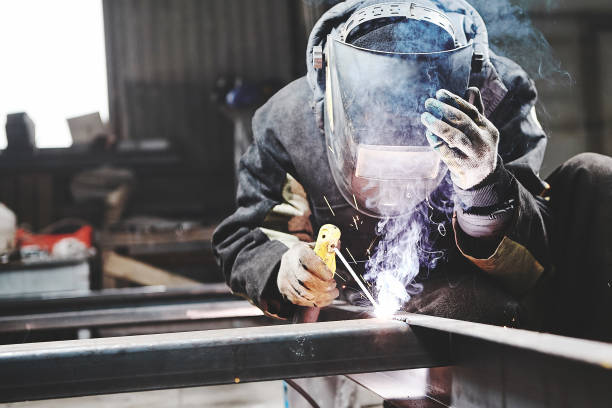
Imagine this scenario: You’re in the final stages of a high-precision pipe welding job. The weld pool is flowing flawlessly, and you’re just seconds away from a “perfect weld.” Suddenly, the inside of your welding helmet visor fogs up, instantly turning your vision from clear to blurry. You’re forced to stop working, lift the helmet, wipe the visor, and disrupt your previously perfect welding rhythm.
For any professional welder, fogging of the helmet is the number one enemy of efficiency and safety . You might instinctively question the helmet’s quality—”Is this a design flaw?” But scientifically speaking, it’s often an inevitable consequence of physics . However, professional-grade protective gear shouldn’t easily succumb to the laws of physics.
This article will thoroughly analyze the science behind fogging of welding helmet visors (the deadly combination of humidity and temperature difference ) and provide you with three professional-grade anti-fog solutions. We will conduct a comprehensive analysis from optical coatings and chemical interventions to active exhaust systems to help you maintain clear vision in all weather conditions , ensuring the quality of your welds and your work safety.
Part 1: The Scientific Principles of Condensation – Is It the Helmet’s Fault ?
Fogging of the lenses is scientifically known as condensation . This is not necessarily a technical defect in the welding helmet itself, but rather a result of the humidity and temperature differences in the environment creating a microclimate inside the helmet that triggers condensation.
Humidity and temperature difference: the formation of the **”dew point”**
When you are working, your body continuously releases heat and water vapor (primarily through breathing and sweat evaporation). This warm, humid air is trapped inside the helmet.
Cold surface effect: When the external ambient temperature is low (such as in winter or in a factory with strong air conditioning), the temperature of the inner surface of the helmet’s outer protective lens will drop rapidly.
Water vapor condensation: When the warm, humid air inside comes into contact with the cold surface of the inner lens , the air temperature drops to the dew point . At this moment, the excess water vapor instantly condenses into tiny liquid water droplets, forming the “fog” we see.
Conclusion: This is a naturally occurring physical phenomenon. However, please note that poorly designed helmets that lack effective ventilation or sealing actively exacerbate this phenomenon, making it a serious flaw in their use.
The safety costs of fog : obstructed visibility and risk exposure
Fog is not just a minor, annoying problem; it poses real safety hazards .
Interrupting welding to clean the lens can introduce weld defects and waste time and materials.
Continuing to operate under limited visibility conditions greatly increases the risk of operational errors and accidental injuries (such as burns, splashes, and tripping).
Part Two: Three Professional-Grade Anti-Fog Solutions (Chemical, Physical, and Optical)
To completely solve the fogging problem, we need to take coordinated measures from three dimensions: optical coating, chemical spray, and physical ventilation.
Solution 1: High-performance anti-fog coating – optical intervention
This is the most modern “chemical weapon” for solving fogging problems, and it is usually built into a high-quality inner protective lens.
Mechanism of action: Reduces the surface tension of water droplets
High-performance anti-fog coatings are hydrophilic coatings. Their working principle is not to prevent water vapor condensation, but rather to reduce the surface tension of water vapor . When water vapor condenses on the coating, it does not form tiny, light-scattering “droplets ,” but instead spreads evenly into a thin, transparent water film. This water film does not interfere with your vision, thus maintaining clear visibility.
Maintenance reminder: The coating is a consumable.
gradually wear off over time, with excessive or improper wiping, and exposure to chemicals . For helmets with replaceable inner lenses, always choose original or high-quality replacement lenses with a permanent anti-fog coating.
Solution 2: Integrated Exhaust System and Active Air Supply – Physical Intervention
This is a “physical weapon” that solves the problem by altering the “microclimate” inside the helmet.
Mechanism of action: Eliminate the root causes of temperature and humidity differences
Some high-end welding helmets or PAPR (Powered Air-Containing Breathing Apparatus) systems employ active ventilation mechanisms:
Vents: By strategically designing vents at key locations on the helmet , warm, humid air inside can be quickly expelled while ambient air is introduced.
Active Airflow (PAPR): The PAPR system not only provides welders with filtered fresh air, but its continuous, slight positive pressure airflow can also directly and effectively prevent the condensation of hot and humid air inside the lens, making it the most effective anti-fog method .
Solution 3: Anti-fog sprays and gels – chemical topical application
For standard helmets that do not have advanced ventilation systems, dedicated anti-fog sprays or gels are an economical and effective short-term solution.
Key to application: uniformity, appropriate amount, and natural film formation.
Choose a product specifically designed for polycarbonate lenses . The key to application is to apply evenly and allow it to air dry to form a clear film, rather than wiping it off immediately. Over-application or uneven application can result in distorted vision or residual streaks.
Part Three: Daily Maintenance and Preventative Habits
To maximize the effectiveness of anti-fog measures, good daily maintenance and work habits are required.
Keep dry and preheated
Store in a dry place: Always store your welding helmet in a dry environment. If the sweat-absorbing liner inside the helmet gets damp, it will act like a sponge, constantly releasing moisture into the closed helmet.
Preheating adaptation: Before entering the extremely cold welding area, place the helmet in a slightly warmer environment for a few minutes to allow the lens temperature to adapt in advance, reducing the temperature difference with the internal air .
Breathing control and mask seal
Wear a mask: In extremely cold environments, consider wearing a thin breathing mask inside your helmet to direct most of the exhaled moisture downwards, rather than spraying it directly onto the inner surface of the lens.
Check the seal: Ensure that the visor of the welding helmet (if any) seals well between your cheeks and chin to prevent accidental convection of cold outside air or hot, humid inside air, which could disrupt the microenvironment inside the helmet.
Summary and Reflection: Security Begins with Continuous Clarity
Fogging of the visor is not an inevitable fate for welding helmets ; it is a physical product of humidity and temperature differences . A well-designed helmet and proper maintenance practices should be able to manage and eliminate this physical effect through anti-fog coatings, efficient exhaust systems , or active ventilation .
anti-fog solutions that provide consistently clear vision is the best guarantee for your work efficiency, weld quality, and long-term safety . Don’t let a blurry lens become an obstacle to your perfect weld.
Reflection and Questions: In your work environment, do you think fogging is mainly caused by high humidity (e.g., in the south during summer) or large temperature differences (e.g., in the north during winter)? Do you prefer using disposable anti-fog spray or investing in a helmet with active ventilation ? Please share your anti-fog experiences in the comments section!