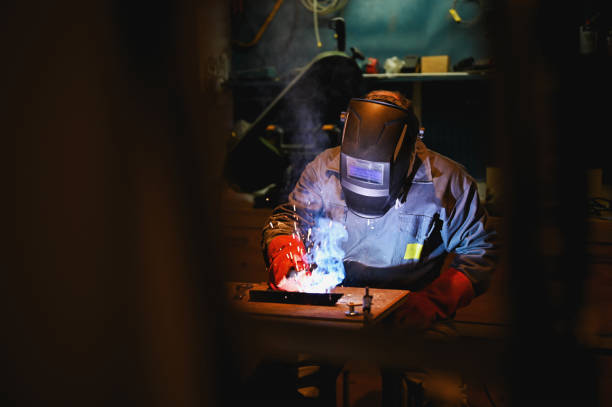
As welders, we instinctively know the importance of welding helmets for our eyes and skin. We strictly adhere to welding safety regulations to ensure our eyes are not burned by the arc light. However, in focusing on these obvious threats, have we overlooked a more insidious enemy—the smoke and gases suspended in the air ?
Welding fumes contain heavy metal particles such as chromium, nickel, and manganese, as well as toxic gases . Once inhaled, these fine particles can become a silent killer leading to chronic lung diseases such as “welder’s lung.”
The good news is that modern technology offers the highest level of respiratory protection : the PAPR (Powered Air-Filtering Respirator) system. This article will provide an in-depth analysis of how to integrate a welding helmet with a PAPR system. The integrated system works perfectly to provide comprehensive protection from head to lungs.
I. Why are traditional protective measures no longer sufficient? PAPR The necessity
With increasingly stringent welding safety standards, traditional protective measures are facing severe challenges.
Limitations of traditional masks
Poor seal: The biggest problem with disposable N95 masks is that they struggle to maintain a perfect seal against the face under the pressure of a welding helmet and sweat . Any tiny gap can allow contaminants to leak from the sides, significantly reducing their protective effectiveness.
Low comfort: Wearing a tight traditional mask for a long time, especially in high-temperature environments, can increase breathing resistance, causing users to feel difficulty breathing and stuffy discomfort.
PAPR Active Respiratory protection revolution
PAPR system completely changed the landscape of respiratory protection . It is no longer a passive filter, but an active air delivery system:
Working principle: PAPR uses a battery-powered air supply unit to continuously deliver filtered fresh air into the welding helmet under positive pressure .
Core advantages: Positive pressure effectively creates an airflow barrier, preventing external contaminants from entering the mask. This not only eliminates concerns about sealing but also significantly reduces breathing resistance , providing exceptional comfort and allowing welders to maintain high efficiency even during high-intensity, long-duration welding operations.
II. Integrated Combination: Welding helmet and PAPR The perfect solution
The effectiveness of the PAPR system depends on its integration with the welding helmet .
Choose a compatible welding helmet – an integrated design is key.
You cannot mix and match them arbitrarily. High-efficiency PAPR must be used with a specialized welding helmet :
Integrated design: Choose a professional helmet with an integrated design (such as the 3M Speedglas Adflo or Miller T94 series). These helmets have pre-installed airflow duct interfaces and are optimized to ensure that airflow is evenly distributed to the face.
Sealing Skirt: These professional integrated helmets typically feature a soft and durable sealing skirt below the face . This skirt is key to maintaining a positive pressure environment. Working in conjunction with the positive pressure generated by PAPR , it ensures that the air pressure inside the visor is always higher than the outside, preventing contaminants from entering.
H3: PAPR The core components of the system and their maintenance
PAPR is a systems engineering project that requires regular inspection and maintenance of its core components.
Air supply unit (blower): Ensures that the battery life reliably covers a full shift (usually recommended to be more than 8 hours ) to avoid exposure to smoke and dust due to power depletion during the shift.
Filter components: These are the “lungs” of the system. Depending on your welding materials and processes, you may need:
Particulate filters (HEPA/P100): filter solid contaminants such as welding fumes and metal particles.
Odor/Gas Filter (Optional): Used to treat harmful gases produced by special welding processes, such as zinc vapor from welding galvanized sheets or organic vapor from welding aluminum .
Maintenance: Regularly check the pre-filter for blockage by large particles and replace the main filter promptly based on usage frequency and environmental conditions . This is the lifeline for maintaining the high efficiency of the PAPR system.
III. Advanced Functions and Ergonomics Consideration
PAPR is not only about security, but also greatly enhances the user experience.
Airflow distribution and Comfort
Cooling and Anti-fogging: The superior PAPR system allows users to adjust airflow distribution , such as directing most of the airflow to the eyes and face. This not only provides fresh air but also cools and prevents fogging , which is crucial for enhancing comfort during extended wear .
Alarm system: A reliable integrated system must have audible and visual alarms for low battery and insufficient airflow . Once the filter components become clogged or the battery is depleted, the system will immediately alert the user to avoid unknowingly reducing the protection level.
System weight and balance
PAPR The air supply unit and battery are typically designed to be worn around the waist and connected to the welding helmet via an air tube . This design cleverly avoids increasing the head weight of the welding helmet , thus maximizing the helmet’s weight balance and ergonomic advantages, and reducing pressure on the neck.
in conclusion: Upgrade your Welding safety standard
In modern welding work, the PAPR system is no longer a dispensable accessory, but an indispensable advanced protective system . It upgrades your welding helmet from passive protection that is merely “visible” to active respiratory protection that is “breathable” .
Investing in a PAPR integrated system is like taking out an insurance policy for your occupational health and productivity for decades to come.
Take immediate action: Inspect your work environment, especially areas involving galvanized parts, stainless steel, or heavy dust. If conditions are severe, consult a reputable brand immediately to upgrade your respiratory protective equipment. Your lungs deserve better protection.