If you’re a welder, you might be carrying heavy loads on your head for hours every day. Even the lightest welding helmet , with its weight concentrated in front of your face, puts chronic stress on your cervical spine and shoulder muscles . This constant fatigue not only reduces your precision and efficiency but can also lead to serious occupational diseases in the long run.
The real enemy isn’t the helmet’s absolute weight , but rather the misalignment of its center of gravity . A poorly adjusted headband system forces your neck muscles to make unnecessary compensatory contractions, leading to pain and stiffness.
This article will reveal the hidden ergonomic secrets of welding helmet headband systems , teaching you how to find the helmet’s “zero-gravity” balance point through precise center of gravity adjustment and tilt setting . This is key to transforming your work gear from a “burden” into a “body extension,” significantly reducing neck fatigue and keeping you refreshed after a long day.
Biomechanics of fatigue : Why is your neck “working overtime”?
To address neck fatigue, we must understand from a scientific perspective how the weight of a helmet exerts forces on your body.
Helmet center of gravity: the amplification principle of leverage effect
Why does a 1.5-pound helmet feel like 4 pounds?
The weight distribution of a helmet follows a simple lever principle . Because the ADF filter is located in front of your face, the helmet’s center of gravity naturally shifts forward . This is like lifting a lightweight dumbbell at the distal end, but the torque exerted on the proximal end (your cervical spine) is greatly amplified. Your neck muscles are forced to act as a continuous **”stabilizer”**, constantly contracting to counteract this forward tilting torque.
This sustained static contraction can quickly lead to lactic acid buildup and muscle fatigue. A helmet weighing 1.5 pounds (about 0.7 kilograms) can exert the equivalent of a continuous load of 3 to 4 pounds on the neck if the center of gravity is shifted too far forward .
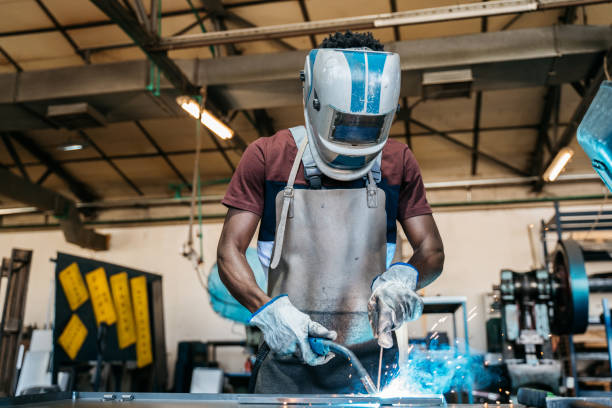
Headband Design: From Single Support to Pressure Distribution
high-quality welding helmet headband system is to distribute weight and pressure evenly across the safe area of your head by maximizing contact area and providing multi-point support.
Looking for multi-point support and shock-absorbing pads
A professional headband system should not only have multiple adjustment points but also comfortable, moisture-wicking padding . A high-quality headband distributes the helmet’s weight evenly across the head, rather than concentrating it on the top of the head or forehead. Ensure your padding is clean and elastic; it’s the unsung hero that helps achieve even weight distribution .
Precision Adjustment : Balance, Pivot, and Deflection
Adjusting the headband of a welding helmet is not simply a matter of “wearing it tight”; it is a precise art of balance and angle .
Key technique: Pivot adjustment .
Many high-end welding helmets feature an adjustable pivot point . This is the ultimate key to eliminating neck fatigue .
Find the perfect alignment between the center of gravity and the center of the head.
By fine-tuning the pivot nuts or knobs on both sides of the headband, you should try to shift the helmet’s center of gravity as far back as possible , aligning it with the vertical axis of your head . Ideally, the helmet should maintain its raised or lowered position when your neck is relaxed, without jerking forward or backward . When this center of gravity is perfectly balanced, your neck muscles will shift from a continuous “resistance” mode to a relaxed “holding” mode, significantly reducing fatigue.
Personalized calibration of the viewing angle
When you lower your helmet, the angle at which you look at the weld pool (the downward angle) directly affects your neck posture.
Lock in the best view and relax your posture
The professional headband system allows you to adjust the angle of the filter . Your adjustment goal is to ensure your head is in the most natural and relaxed position while soldering , avoiding excessive raising or lowering of the chin to obtain the best field of vision .
If the tilt angle is too high: you may need to tilt your head back excessively , causing excessive tension in the muscles at the back of your neck.
If the tilt angle is too low: you may be tilting your head down too much , putting pressure on the front of your neck and shoulders.
Please conduct actual tests at the workbench until you find the “sweet spot” where you can look directly at the solder pool and feel most relaxed in your neck.
Precise positioning of the stop position relative to head height
These two adjustments affect the helmet’s positioning and comfort when not in use.
Stop position: Adjust the helmet to the stop position when it is raised to ensure that it does not hit your neck or back when you raise your head.
Head height: The adjustable headband ensures a snug fit to your head shape. A perfect fit is fundamental for even weight distribution .
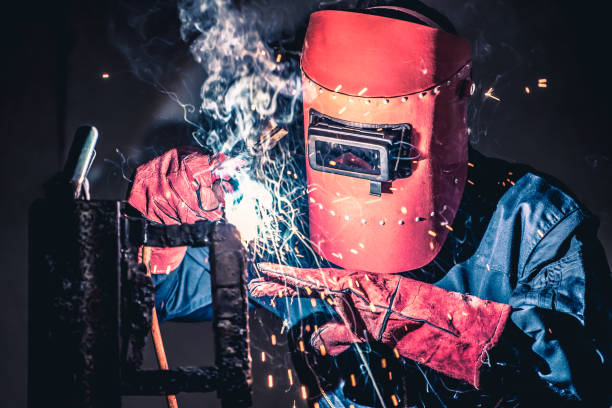
Continuous optimization : Ergonomic habits that go beyond adjustment
Even if your welding helmet is perfectly adjusted, persistent occupational fatigue still requires good work habits to alleviate.
Intermittent stretching and posture correction
Neck and shoulder fatigue requires regular “release valves”.
Mini-breaks every hour: Use the time between changing clothes or waiting for the neck to cool down to do simple neck and shoulder stretches . Gently rotate your head to the sides and back and forth to promote blood circulation and remove lactic acid.
Stabilize your core: Keep your core area stable to avoid putting all your weight on your arms and neck. A stable core can distribute most of the pressure from the helmet.
Headband routine maintenance : Keeping it in good condition
The headband system is the component most prone to wear and contamination. Regular maintenance can preserve its shock absorption and support capabilities.
Cleaning and replacing the gasket: Sweat pads should be removed, cleaned, or replaced regularly, as worn or collapsed pads can cause pressure to concentrate.
Fastener check: Ensure all adjusting screws and pivot points are properly tightened to prevent the helmet from slipping or tipping over during operation.
Summary and Reflection: Safety Begins with Comfort and Balance
The optimal balance point for a welding helmet is a perfect combination of ergonomics and personal adjustment. By mastering the art of precise adjustments to the center of gravity, pivot, and tilt angle , you can minimize pressure on your neck. This isn’t an optional “comfort” optimization, but an essential means of ensuring your long-term occupational health and improving work efficiency .
your welding helmet as an extension of your body, not as a heavy object to be resisted.
Reflection and Questions: Have you ever neglected adjusting your helmet ‘s pivot point ? How much did neck pressure decrease after you found perfect balance? Please share your unique tips for adjusting your welding helmet to eliminate fatigue in the comments !