
Your Automatic Dimming Light (ADF) welding helmet is based on a simple promise: it dims instantly the moment the arc ignites. But the realization of this promise depends entirely on those tiny, inconspicuous arc light sensors on the outside of the helmet .
In the real world of welding, things are far from ideal: when you’re doing out-of- position welding , your arm, the welding torch, and even the edge of the workpiece can cast shadows between you and the arc light, obstructing the sensor . Whether it’s this physical obstruction or interference from strong outdoor sunlight, it can cause the light-changing failure—that one “flash” can not only cause temporary blindness but also potentially permanent damage to your eyes.
This article will delve into the practical differences between using 2, 3, and 4 sensors on an ADF filter, revealing why, in the most demanding remote and outdoor environments, an extra sensor can mean a decisive difference between safety and risk .
Part 1: The Mission of Sensors – Combating Obstruction and Interference
The core function of an arc sensor is to quickly and accurately identify the presence of an electric arc. The number of sensors and their geometric arrangement on the filter directly determine the reliability of the ADF in complex welding environments .
Two major challenges facing arc light sensors
Challenge 1: Physical Obstruction: This is the most common problem in off-site welding . When welding overhead or vertically, the welder’s arm, the angle of the welding torch, or the workpiece itself can all create blind spots between the sensor and the arc . If the arc light falls in the sensor’s shadow area, the light-changing function will fail, resulting in “flash”.
Challenge 2: Environmental Interference: The most typical interference is outdoor sunlight or strong reflected light. Sensors must be able to distinguish between continuous, uniform ambient light and localized, high-intensity, sudden arcing light . A large number of widely distributed sensors, combined with sensitivity adjustment, can better differentiate these signals .
Part Two: The Evolution of Quantity – From “Amateur” to “Industrial”
a welding helmet is the most direct indicator of its professionalism and the complexity of its application .
Two-Sensor : An Entry-Level Option
Configuration and limitations: These sensors are typically located in the center of the left and right sides of the ADF filter . This configuration is highly susceptible to physical obstruction . If the arm or welding torch deviates even slightly from the central axis, causing any sensor to be blocked, the reliability of the light-changing effect will drop drastically.
Applicability: Only suitable for flat-position welding in basic welding environments with a neat workbench and open field of vision . Not recommended for any form of off-position welding .
Three-sensor : The passing grade for professional work
Configuration and Improvements: In addition to the existing left, right, and center sensors, a sensor is typically added above the center . This partially compensates for potential obstructions when welding from above.
Applicability: Suitable for production lines or workshops with certain off-site requirements .
Remaining issues: When welding complex pipelines or when the head angle needs to be changed significantly, the blind spot at the lower side angle still exists, and the risk of light conversion failure is higher than the industry standard.
Four-sensor system : standard for industrial applications and off-site welding.
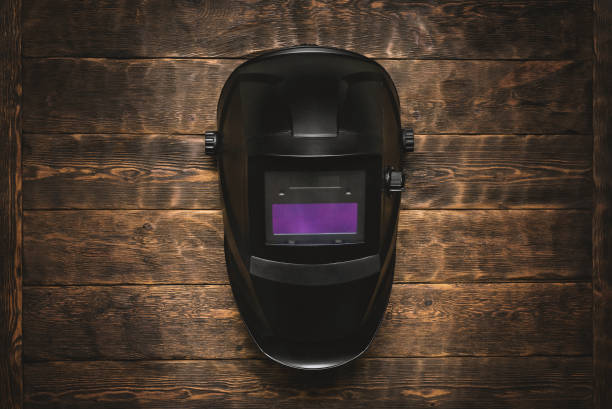
Configuration and advantages: Typically, there is one monitoring point on the upper part and one on the lower left and right sides, forming four evenly distributed monitoring points.
Core protection:
Redundancy: This is crucial. Even if one or two sensors are blocked, the remaining sensors can still effectively capture the arc light. This greatly reduces the risk of “flashes” .
Full-angle coverage: This geometry maximizes the protection of the arc field of view by at least one or two sensors, regardless of the angle of your welding operation, whether you are in overhead, vertical, or side welding .
Part Three: Practical Effects in Non-Ideal Environments
The increased number of sensors is an engineering solution specifically designed for non-ideal welding environments , aimed at improving reliability .
Displacement welding: Eliminating the “geometric blind spot”
When working in confined spaces such as inside pipes or containers, or performing overhead welding, you and your welding torch are the biggest sources of obstruction .
For example, when you have to insert the welding torch from below and perform overhead welding , the torch and workpiece can easily cast shadows on the lower sensor of the ADF filter . If the helmet has a four-sensor configuration, the upper or side sensor will activate the redundancy mechanism , successfully triggering the light change. With two sensors, you will almost certainly “flash”.
Outdoor and high-frequency welding: Signal discrimination capability
While the number of sensors cannot directly solve the problem of sunlight interference , multiple sensors combined with advanced technology can improve their signal discrimination capabilities.
Reduce false triggers: With the four sensors working together to adjust sensitivity , it is possible to more accurately determine whether the light signal comes from an electric arc (high intensity, local, sudden) rather than a large area of ambient light (sunlight).
Innovative technologies such as X-Mode: Some high-end four-sensor helmets (such as Miller’s X-Mode) even integrate electromagnetic induction technology . It does not rely on light, but triggers light changes by sensing high-frequency current changes, thereby completely eliminating sunlight, shadows and any optical interference , providing near-absolute reliability in outdoor and displacement welding.
Summary and Reflection: Safety is a Mathematical Choice
In the world of welding helmets , the number of sensors is essentially a mathematical choice of reliability . More sensors mean a larger arc light capture geometry and higher reliability in light variation , which is crucial for your eye safety.
If you’re an amateur welder who only does flat welding in a controlled room, two or three sensors might be enough. But for any professional welder working with complex angles, high risks, outdoors, or in high-precision locations , four sensors are the minimum standard investment to ensure uninterrupted light changes and protect your eyes .
Reflection and Questions: What are the most common sensor obstruction situations you’ve encountered in your work (e.g., welding torch or surrounding structure)? Do you think that besides increasing the number of sensors, technologies like X-Mode that don’t rely on optics will become the sole standard for high-end helmets in the future ? Please share your thoughts in the comments section!