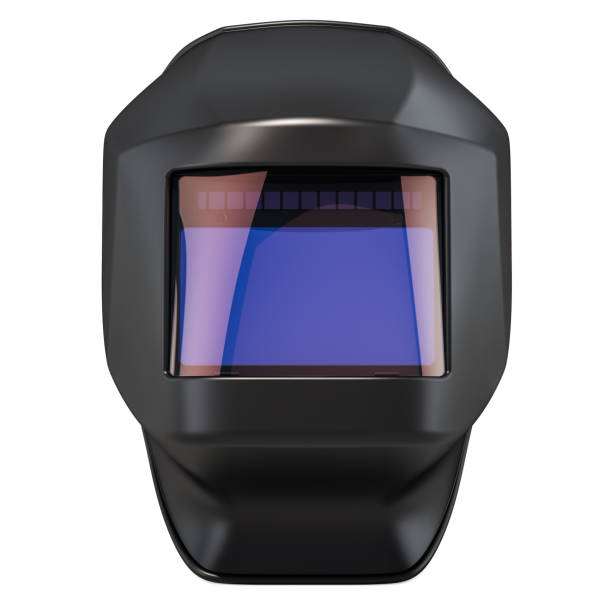
If you’ve ever done welding, you know the painful experience: to protect your eyes, you have to abruptly lower your helmet the moment the arc is ignited . This “nodding” welding technique is not only inefficient but also frequently leads to misaligned welds. Even worse, even a brief exposure to the intense arc light can cause photokeratitis (commonly known as “welder’s eye”), a feeling similar to having sand in your eye that lasts for hours.
Fortunately, we live in an era of technological revolution. The advent of Auto-Darkening Helmets (ADH) has completely changed all that. Their core promise is: danger is averted before you even realize it.
This revolutionary technology is no magic trick, but rather the result of precise collaboration between sensors and an LCD screen . This article will take you inside this high-tech welding mask , revealing how it transforms from transparent to light-blocking in milliseconds , providing you with real-time, worry-free protection.
I. Core Brain: photoelectric sensor —The “Gatekeeper” of Light
Automatic dimming The secret of the welding helmet begins with its sensor array. You can think of them as the helmet’s light radar , constantly alert to changes in the surrounding environment.
Sensor Array and Working Mechanism
A professional automatic variable-voltage welding mask is typically equipped with two to four or even more photodiodes . These are carefully arranged in front of the lens to ensure that the arc light can be captured from all directions without any blind spots.
Comprehensive capture: These sensors can not only detect strong light in the visible light spectrum , but more importantly, they can also target the two invisible “killers” of ultraviolet (UV) and infrared (IR) rays.
Signal conversion: The light intensity spikes the moment you ignite the arc. Once the sensor detects that the light intensity exceeds the helmet’s preset safety threshold, it will instantly convert the light signal into an electrical signal and send it directly to the LCD screen via the circuit board .
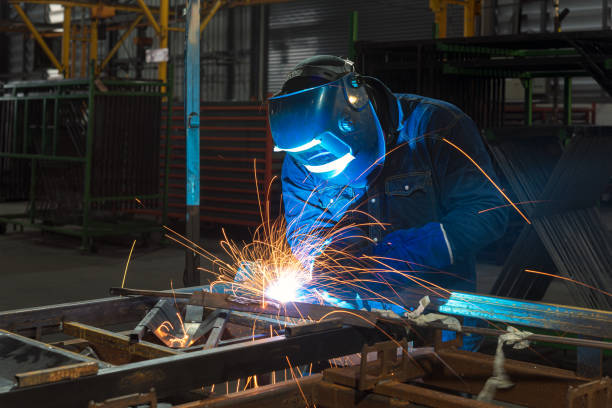
Sensitivity adjustment: adapting to every minute welding scenario.
automatic headlight adjustment technology is its adjustability . Welders can adjust the sensitivity of the sensors to adapt the helmet to various complex working conditions.
TIG welding challenges: TIG welding typically uses lower currents, resulting in relatively weaker light intensity. In this case, you need to increase the sensitivity to ensure that even a weak arc light can trigger a change in brightness instantly.
Outdoor or reflective environments: If you are outdoors or there are other welders nearby, you need to lower the sensitivity to prevent the helmet from being mistakenly triggered to change light by irrelevant sunlight or reflected light .
It is this precise adjustment that makes the sensor an indispensable “smart” component in the automatic light-changing welding helmet .
II. Color-changing core: LCD screen The microscopic “instantaneous transformation”
If sensors are the brain that issues commands, then the LCD screen (Liquid Crystal Light Valve) is the precise executor.
Liquid crystal light valve: Sandwich-style structural protection
automatic light-changing lens is not a simple plastic sheet, but a sophisticated multi-layered composite structure that we can call a “liquid crystal light valve”:
Permanent UV/IR Filter: This is your ultimate safety guarantee . Located inside the LCD layer, it provides permanent protection against ultraviolet and infrared radiation even if the LCD screen ‘s electronic system completely fails (no power or damage), ensuring that harmful radiation will never damage your retina.
Polarizers: Two layers, like two Venetian blinds, used to control the direction of light transmission.
Liquid crystal layer: sandwiched between two polarizers, it is composed of countless liquid crystal molecules , which are like tiny soldiers, ready to change their orientation at any time upon receiving instructions.
Unveiling the Millisecond-Level Light-Changing Process
The entire process from light to dark is like a slow-motion scene in a movie, but it actually only takes 1/20,000 of a second or even less in the blink of an eye .
Light State: When there is no arc, no electrical signal passes through. The liquid crystal molecules are arranged in a twisted pattern, allowing light to pass through with a low level of opacity (usually DIN 3, sufficient for clear visibility).
Dark State: After the sensor sends an “arc ignition!” electrical signal, current is immediately applied to the liquid crystal layer . The liquid crystal molecules instantly align themselves. At this moment, light is effectively blocked as it passes through the upper and lower polarizers and the liquid crystal layer.
Light-changing effect: The lens changes from transparent (DIN 3) to completely black (e.g., DIN 11) within milliseconds , achieving the welder’s preset level of darkness . This extremely rapid response far exceeds the human eye’s reaction to strong light, truly achieving real-time protection.

III. Drive and Range: A Clever Balance of the Energy System
To achieve this instantaneous light change, a continuous and stable power supply is required. Excellent welding masks understand the importance of long-lasting power:
Hybrid power supply mode: Most modern welding helmets use a hybrid power supply mode of solar cells and lithium batteries .
The clever uses of solar energy: Solar cells primarily utilize arc light during the welding process to continuously charge the system. This significantly reduces the burden on lithium batteries and improves battery life.
The role of lithium batteries: Lithium batteries serve as backup power and a guarantor during startup . They ensure that the LCD screen has enough power to instantly trigger the brightness change when the sensor detects current arcing (such as in some TIG welding) or during initial startup .
Conclusion and Outlook: Invisible Innovation, Visible Value
The automatic light-adjustable welding helmet is a product of the perfect integration of microelectronics, optical materials, and ergonomics. It tells us that the highest level of safety is often imperceptible —it appears when you need it and disappears when you don’t.
The sensor handles precise detection, while the LCD screen handles rapid execution. It is this millisecond-level coordination between the two core components that solves the biggest safety hazards and efficiency pain points for welders.
The next time you put on your automatic color-changing welding helmet , remember that you’re not just wearing a tool, but a sophisticated protective system with a miniature supercomputer . With the increasing prevalence of “natural color” and larger high-definition LCD screens , future welding helmets will become increasingly intelligent, providing professional welders with clearer and safer visibility.
Think about it: In your daily welding work, which scenario best demonstrates the effect of automatic light adjustment? What is the value of welding helmets ? What sensor technologies do you think will be incorporated into future welding masks ? Feel free to share your thoughts in the comments section below!