https://www.aconfront.com/the-ultimate-guide-to-custom-welding-helmets-personalization-accessory-upgrades-and-workflow-optimization/
For any skilled welder, welding work is rarely a simple “spot welding” task. In fact, welding is a cycle: cleaning (grinding the bevel) → welding → cleaning (grinding slag and spatter).
In the past, this meant that welders had to constantly go through the tedious process of “removing the helmet, putting on goggles, picking up the grinder, removing the goggles, and putting on the helmet again.” This not only wasted time but also increased the risk of head and eye injuries due to the frequent operations.
This is the significance of the ” Grind Mode ” on modern automated variable-speed welding helmets . This seemingly simple function represents a major improvement made by manufacturers based on ergonomic and safety considerations. This article will thoroughly reveal the function, principles, and correct usage scenarios of this mode , teaching you how to use it to improve efficiency while ensuring safety.
I. Function Analysis: The grinding mode locks in the bright state, freeing up your hands.
Simply put, the grinding mode is the ” grinding mode ” of your welding helmet . It transforms the helmet from an automatic light-changing device into a high-strength protective face shield with a simple operation .
Grind Mode core functions
When you activate the grinding mode , your welding helmet will do the following:
dimming function disabled: The automatic dimming function on the filter is locked . This means it will not dim in response to arc light.
Locked Brightness: The lens is fixed at its brightness level (usually DIN 3 or DIN 4). This brightness level is sufficient to allow you to clearly see the work area.
Purpose: To allow welders to grind, deburr, or cut welds using an angle grinder or cutting tools without removing their helmets .
Invisible security measures in bright states
You might worry: Does being locked in a bright state mean a radiation risk?
The answer is: No. This is the most critical safety principle in the grinding process .
According to authoritative welding standards such as ANSI Z87.1 or CE EN379 , the filters of high-quality welding helmets must provide permanent ultraviolet (UV) and infrared (IR) radiation protection, even in bright conditions or when the battery is faulty .
Therefore, when you are in grinding mode , your eyes:
Protected from radiation: Continuously protected from UV/IR radiation.
Protected from physical damage: The helmet shell and filter itself effectively protect against high-speed sparks and metal shavings generated during grinding.
How to activate the grinding mode – Professionalism in the details
Professional-grade welding helmets typically use an external physical switch (button or lever) to activate the grinding mode . This design allows welders to quickly and accurately switch between welding and grinding modes even while wearing heavy gloves , minimizing interruptions and distractions.
II. Use Cases and Life-or-Death Situations Safe Operation
The grinding mode greatly improves work efficiency, but it is also a double- edged sword . If you operate it incorrectly, the consequences will be disastrous.
Grinding mode Golden application scenarios
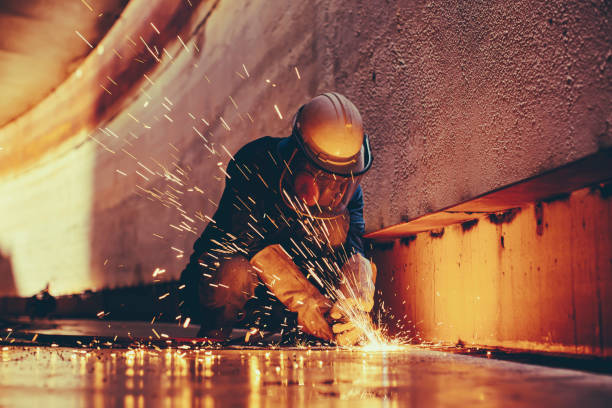
Weld cleaning and surface treatment: This is the most common application. Use an angle grinder to remove weld slag, spatter, or oxide layers from the weld.
Beveling: Before making a new weld, the edges of the material are precisely ground to ensure that the subsequent weld will have maximum strength.
Plasma/oxyacetylene cutting assistance: When performing low-intensity cutting operations, the grinding mode provides a clear field of view while ensuring physical protection.
Life-or-death safety operation warnings
If you only remember one rule, it is: DO NOT DO NOT perform welding in grinding mode!
as a result of: The dimming function is disabled in grinding mode . If an arc is ignited in this mode, the intense arc light can instantly burn the eyes, causing severe “Arc Flash,” resulting in temporary blindness and intense pain.
Always check mode: “Confirm first, then operate” should be your mantra.
Before you begin grinding , you must make sure that the mode has been switched to “grind” (bright mode).
Before starting the welding process , you must ensure that the mode has been switched back to “Welding” (automatic light adjustment is activated).
The bottom line for physical protection: Even in abrasive mode , your helmet shell and visor must have sufficient impact resistance (e.g., ANSI Z87+ certification) to withstand high-speed flying metal sparks and abrasive particles.
In conclusion: Master your tools, safeguard your health
The grinding mode is an underrated but crucial feature on modern welding helmets . By locking the automatic light-changing function, it allows welders to seamlessly and safely switch between grinding and welding operations.
Mastering and correctly using grinding modes can not only save you a lot of time in putting on protective gear, but is also an important part of ensuring your safe operation and long-term occupational health.
Take immediate action: Regardless of the type of welding helmet you use , locate the grind mode switch now. Ensure you and your team clearly understand how to quickly, accurately, and safely switch between welding and grinding . Your eyes deserve your utmost care.
https://www.aconfront.com/the-ultimate-guide-to-custom-welding-helmets-personalization-accessory-upgrades-and-workflow-optimization/