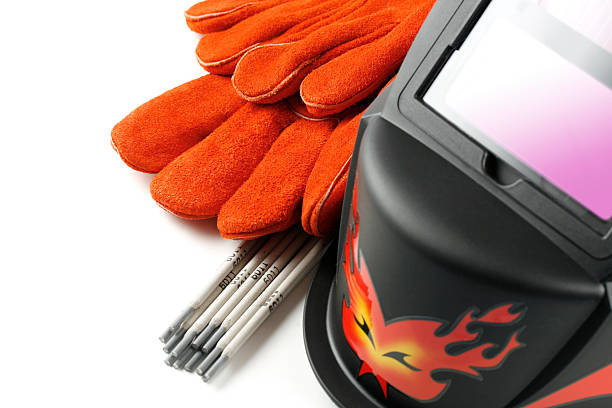
In modern welding workshops , the welding helmets you see are high-tech personal protective equipment (PPE) that can instantly darken, freeing your hands. But imagine this: before each arc strike, you have to use a bulky black mask , forcefully “nod” to throw it off, and then position the welding torch by feel. This clumsy and inefficient operation has dominated the welding industry for decades.
welding helmets is not merely a reflection of advancements in materials and technology; it represents the industry’s relentless pursuit of worker safety and productivity . This article will take you through this “revolution in the dark,” from the initial traditional welding masks to the revolutionary light-sensitive liquid crystal lenses , revealing how each technological leap has fundamentally changed welding processes and the working lives of welders.
I. The Starting Point of History: Traditional welding mask The era of “passive protection” (1900s – 1980s)
For most of the 20th century, welding protection remained at the most basic and passive stage.
“Black glass” and clumsy fixing Light blocking
Origin and Materials: Early welding masks were mostly made of black mineral glass or hardened fiber materials . Their core function was simple and straightforward: to provide fixed, continuous UV/IR radiation protection and protection against spatter .
Core challenges: Fixed Shade Level. Before striking the arc , the welder must use the strength of his head and neck to lower the mask through a “nodding” motion .

Sacrifice of efficiency: Nodding gesture With difficulty in positioning
This passive operating method imposes significant limitations on welding efficiency and quality :
Efficiency bottleneck: Each arc initiation and cessation requires physical manipulation of the helmet , severely disrupting the workflow. It’s like having to manually open a lid every time you want to look at your phone screen.
Safety concerns: Because the welding mask can only be lowered at the moment of arc ignition , welders must rely on feel to position the welding torch during the brief darkness of the lowered mask . This results in low accuracy in arc ignition and positioning , a significant reason for unstable welding quality and high rework rates in the early stages .
II. Technological Transition: Enhanced Passive Protection (1970s – 1990s)
Before the advent of automatic light-adjusting technology, engineers tried various methods to improve the shortcomings of traditional face masks .
Experiments and Limitations of Pneumatic Face Masks
This period saw the development of mechanical linkage devices designed to liberate welders’ heads , such as using foot pedals or arms to raise and lower the mask . However:
Limitations: These systems are generally complex, bulky, and expensive . More importantly, they still cannot solve the problem of field of view at the moment of arc initiation , and the complexity of operation introduces new workstation limitations.
Introduction Polycarbonate lenses (PC) – A Triumph for Materials Science
While filter technology stagnated, breakthroughs were achieved in the materials for mask housings and protective sheets .
Materials Breakthrough: Polycarbonate (PC) is widely used. As we know, polycarbonate has extremely high impact resistance , which greatly improves the ability of face shields to resist high-speed metal spatter (especially from grinding and polishing), representing a significant advancement in eye safety .
III. Disruptive Innovation: Automatic dimming technology The birth and maturation of (1980s – present)
The real revolution came from liquid crystal technology .
Swedish invention: Breakthrough in liquid crystal (LCD) filters
Key time point: Auto-Darkening (ADF) technology was first commercialized by Swedish companies such as Speedglas in the early 1980s.
Core technologies: ADF utilizes the current-response characteristics of liquid crystal . When the sensor detects an electric arc , it instantly sends a current to the liquid crystal layer , enabling the filter to switch from a bright state (Shade 3/4) to a dark state (Shade 9-13) in milliseconds (typically faster than 1/10,000 seconds).

The Evolution of “Electronic Eyes”: Sensors and Power Sources
ADF technology has never stopped evolving:
Sensor upgrade: ADF has evolved from its initial two sensors to four or more sensors today, greatly improving its sensitivity and reliability for low-current TIG welding .
Power strategy: Solved the early battery life problem and developed a hybrid power supply strategy of solar energy + replaceable battery to ensure stable and reliable light-changing performance in various environments.
The triumph of ergonomics
automatic dimming technology represents a significant leap forward in ergonomics :
Efficiency Improvement: Welders ‘ hands are always free , which greatly improves the accuracy of arc positioning and enables continuous operation , thus greatly improving welding efficiency .
Health Improvement: The adjustable dimming delay time, sensitivity , and shading level allow welders to precisely match settings, reducing eye fatigue and thus lowering the risk of long-term vision damage.
IV. Looking to the Future: The trend of integration in smart welding helmets
The evolution of welding helmets continues, with the future trend towards intelligent integration .
PAPR Integration: High-end helmets are deeply integrated with the Powered Air-Purified Filtering Respirator (PAPR) system, providing the highest level of smoke and dust protection by delivering positive pressure air .
Communication technology: Helmets with built-in Bluetooth or communication systems will allow welders to maintain clear voice communication in noisy or high-risk environments, further improving the safety and efficiency of teamwork.
Summarize: The century-long evolution of welding helmets represents a revolution from cumbersome passive protection to active, intelligent protection . It transforms a high-risk, high-skill job into a safer, more efficient, and more comfortable experience.
Guided Action: Think back carefully, in what year was your auto-dimming helmet manufactured? Immediately check the number of its sensors to understand how “smart” your ADF is!