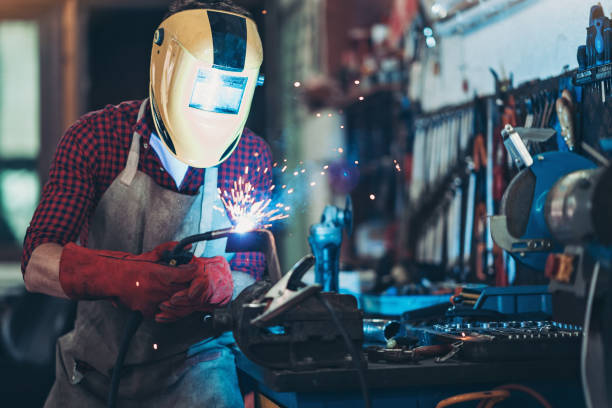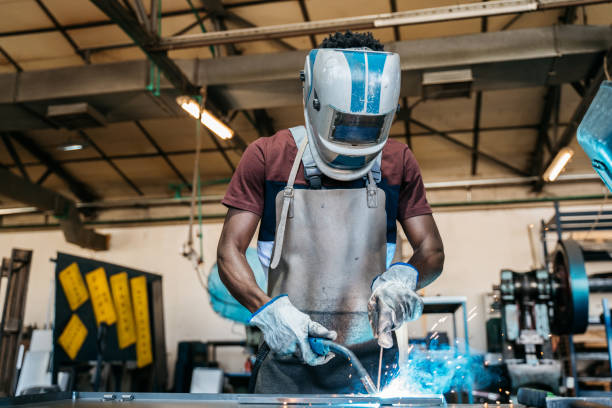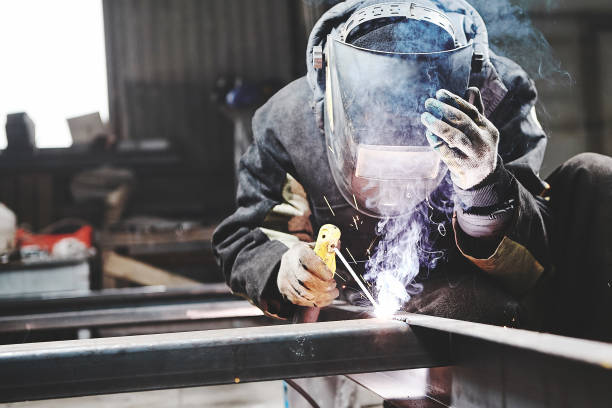
Imagine you’re welding deep inside a large storage tank, a long pipeline, or a ship’s hold. Your protective helmet (welding helmet) is on tight, but you might not realize that the air you breathe is the greatest threat lurking in the darkness. In the welding industry, confined spaces are recognized as among the highest-risk environments. This isn’t just because access is restricted, but also because air quality can change from safe to deadly in minutes .
When the welding flame ignites, you face a double breathing challenge: air is consumed (oxygen deprivation) while toxic substances accumulate (excessive smoke). Standard ventilation systems and ordinary passive protective masks are simply inadequate to handle this severe situation. For professionals working in these hazardous environments, the PAPR welding helmet (Powered Air-Purifying Respirator) is no longer an option; it is the only safety solution to protect your career and even your life .
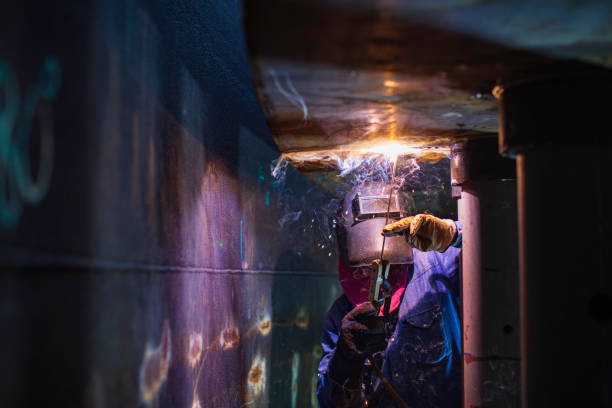
Analysis of the dual respiratory threat of welding in confined spaces
Enclosed spaces are deadly because they disrupt our conventional understanding of “air.” Your lungs are unknowingly exposed to two interconnected and deadly risks.
The Unseen Predators: Oxygen Deficiency and Inert Gases
In a confined space, oxygen is not inexhaustible; it is being passively consumed and actively expelled.
The double whammy of inert gas and oxygen consumption
When you perform TIG or MIG welding, the shielding gases you use (such as argon (Ar) or carbon dioxide (CO₂) protect the weld from oxidation, but they are also highly efficient oxygen eliminators . These inert gases are heavier than air and accumulate at the bottom of the space, quickly replacing the oxygen available for breathing.
Meanwhile, the high-intensity welding work itself burns oxygen in the air. When the oxygen concentration in the environment drops from the normal 20.9% to below 19.5% , the risk of hypoxia begins. Below 16%, judgment is impaired; below 10%, consciousness is lost instantly , which in a confined space is almost equivalent to no one surviving .
Risk of uncontrolled concentration and instantaneous poisoning
Welding fumes consist of submicron-sized particles containing iron oxide, manganese dioxide, and highly hazardous hexavalent chromium. In open environments, these fumes are diluted, but in enclosed spaces, they simply accumulate and accumulate again .
high doses of toxic substances without realizing it , leading to instant poisoning or irreversible damage to the lungs and nervous system .
Limitations of traditional protective measures : failure of standard ventilation
Why can’t we rely solely on ventilation and regular face masks?
Traditional localized ventilation is often inefficient and unreliable in confined and complex spaces (such as those with multiple corners or compartments), as it struggles to accurately extract all the fumes. More importantly, passive welding helmets , regardless of their optical grade, only address visual protection and facial spatter resistance , offering no protection against respiratory toxins and oxygen deprivation . In confined spaces, this “out of sight, out of mind” approach to protection is deadly.
PAPR Welding Helmet : The Only Solution for Safety and Comfort
Facing the dual threats of confined spaces, the PAPR welding helmet offers a scientific and integrated solution. It is not simply a “helmet with a fan,” but an active life support system .
How PAPR welding helmets work: Creating a positive pressure breathing environment
PAPR (Powered Air-Propelled Respiratory Protective System) lies in its active air supply and high-efficiency filtration .
Positive pressure protection : a critical barrier to prevent the infiltration of toxic gases.
The PAPR unit draws in air via a fan, purifies it through a filter, and then continuously delivers it into the welding helmet through a tubing . This continuous airflow creates a slight positive pressure inside the mask . This means that even if your face isn’t perfectly sealed (which is common in welding), the air still flows from the inside out . Any unfiltered fumes attempting to seep in through gaps are blocked by this airflow , ensuring that the welder always inhales clean air.
P100 Filter Cartridge : Highly Effective Interception of Submicron-sized Particles
PAPR systems must be equipped with a P100 (or higher) high-efficiency filter. A P100 filter is a HEPA filter capable of filtering out 99.97% of airborne contaminants larger than 0.3 microns. This is sufficient to effectively intercept various metal oxides and particulate matter in welding fumes , ensuring that every breath you take is safe.
Safety Standards : Understanding the Prerequisites and Limitations of PAPR
According to OSHA and NIOSH regulations, respiratory protection requirements are extremely stringent when working in confined spaces.
Prerequisites for oxygen monitoring : prerequisites for PAPR application
Here is a crucial life warning: PAPR is an air purification system ; it does not provide oxygen .
PAPR welding helmets are strictly prohibited from use if the oxygen content in a confined space is below 19.5% (i.e., there is a risk of oxygen deficiency).
In this situation, you must use a supplied -air respirator, which provides fresh air from a safe area outside.
PAPR is only suitable for environments with normal oxygen levels but high concentrations of toxic fumes .
Four-gas monitor : Vital signs check before entry
Therefore, before entering a confined space, using a four-gas monitor (to detect O₂, LEL, H₂S, CO, etc.) to confirm that the oxygen content is normal and there is no risk of explosion/toxic gas is an indispensable step for the safe use of PAPR welding helmets .
PAPR welding helmet ‘s user experience advantages: cooling and comfort
Besides saving lives, PAPR can also significantly improve work efficiency and comfort in enclosed spaces:
Cooling and Comfort: Continuous, gentle airflow effectively reduces the temperature and humidity inside the welding helmet , avoiding the stuffiness and claustrophobia associated with traditional helmets. This not only reduces the physical burden on welders but also significantly lowers the risk of heat stress.
Dual protection: Integrating an automatic light-changing filter and respiratory protection into one unit, a single PAPR welding helmet solves all advanced protection needs in confined spaces.
PAPR Equipment Pre-departure Inspection and Maintenance Guidelines
Even with the most advanced PAPR welding helmet , it can still fail if proper maintenance and inspection are lacking. Before entering a confined space, inspect your equipment as you would a lunar module.
PAPR Equipment Safety Checklist for Confined Space Operations
Before sealing the welding helmet , please perform the following checks:
Battery and Airflow: Ensure the battery is fully charged and has a backup. Check the airflow indicator or airflow level on the PAPR welding helmet system.
Filter cartridge status: Confirm that the P100 filter cartridge is not expired , has no obvious blockage or color change, and is installed correctly according to specifications.
Air hose integrity: Inspect the air supply hose for kinks, damage, or aging . Ensure the air hose is securely connected to the welding helmet and PAPR unit to prevent accidental detachment or leaks during operation.
Mask sealing: After putting on the welding helmet, perform a simple negative pressure test to ensure a good mask seal.
PAPR System Routine Maintenance : Extending Lifespan
High-efficiency PAPR welding helmets require continuous care:
Clean promptly: After each use, clean the exterior of the welding helmet and the air tube with a mild detergent.
Replacement frequency: Replace the filter cartridge and pre-filter regularly according to the manufacturer’s recommendations and the actual usage environment (smoke concentration). Do not exceed the service life.
Proper storage: Store PAPR units and batteries in a dry, cool place, avoiding direct sunlight, humidity and high temperatures to prevent aging of batteries and electronic components.
Summary and Reflection:
PAPR welding helmets have transcended the scope of traditional protective equipment, becoming a breathing safety fortress for welders in confined spaces . With its scientific positive pressure principle and highly efficient filtration, it successfully transforms the most dangerous working environment into a controllable zone.
In confined spaces, your safety is not a matter of luck, but rather the result of strictly adhering to procedures and trusting in technology. Always remember: your PAPR welding helmet is your lifeline, but it depends on having sufficient oxygen .
Reflection and Questions: Does your work environment adequately prioritize the monitoring of the four gases before working in confined spaces ? Do you consider the battery life of your PAPR welding helmet as a crucial factor in your lifeline ? Please share your safety insights in the comments section!