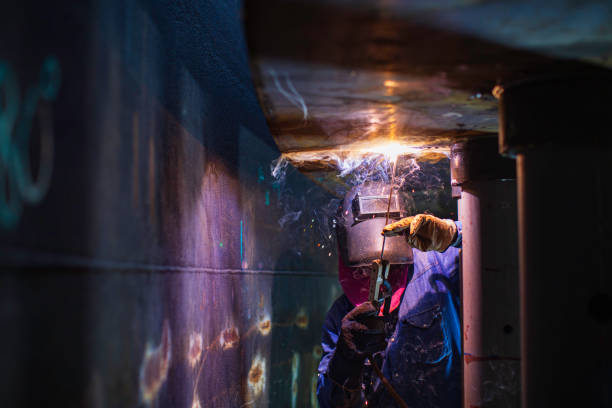
If you’re an expert in the welding world, you know that TIG welding (tungsten inert gas welding) represents the pinnacle of skill: precision, cleanliness, and elegance . But this elegance comes at the cost of extremely low current—sometimes as low as 10 amps or even lower. For your expensive automatic dimming (ADF) welding helmet , that’s like trying to spot an invisible target in the dim light.
When you start TIG welding, if your helmet isn’t sensitive enough, there’s a fatal “hesitation period”—the light changes too slowly, or it simply can’t detect the faint arc light. This brief moment is enough to expose your retina to intense light, leading to one of the most feared occupational diseases among welders: “Arc Eye.”
Choosing a qualified TIG welding helmet should never be a gamble. Its core value lies in its sensor technology and sensitivity limits . This has nothing to do with your budget, but rather with whether your vision protection can accurately lock onto targets in the darkest environments, like a professional scout.

The dual technical pitfalls of TIG welding : pushing the limits of ADF
TIG welding is the most demanding process for protective equipment because of its inherent technical characteristics, which place almost stringent requirements on ADF filters.
Low current characteristic: the challenge of recognition under low light conditions
TIG welding is characterized by the need for extremely high precision and extremely low current input, especially when welding thin plates or critical root passes.
Pain Point 1: The bottleneck of the sensor’s **”light threshold”**
When the welding current is below 10A, or even as low as 5A, the intensity of the arc light is significantly reduced. Many ordinary or low-end welding helmets are designed with a high light threshold; they will only treat such a weak light signal as ambient light and refuse to dim . The result is that you are exposed to a momentary flash of light, which can damage your vision.
Pain Point 2: Electromagnetic Interference of High-Frequency Ignition (HF Start)
TIG welding typically uses high-frequency ignition to establish the arc, achieving contactless and clean ignition. However, this instantaneously released high-frequency electromagnetic radiation is a significant source of electronic interference, which can “dazzle” the circuitry and sensors inside the welding helmet , causing unwanted flickering or dimming failure of the ADF filter . A high-quality TIG welding helmet must be able to withstand this electromagnetic pulse, just like rigorously shielded professional electronic equipment.
Buying Guide: Three Core Indicators of TIG Welding Helmets
For TIG welding, the selection of protective equipment must focus on three core indicators. These together form the basis of the helmet’s reliability under extremely low current conditions.
Key performance indicator 1: Extreme tracking with low ampere sensitivity
This is the “gold standard” for distinguishing between ordinary helmets and professional TIG welding helmets .
Seeking milliamp-level startup commitment
the “low amp TIG start-up capability” listed on its specifications . A true professional-grade TIG welding helmet can reliably activate the swivel function at currents as low as 2A or even 5A . If you frequently perform thin-film or artistic welding, any helmet with a minimum start-up current exceeding 10A should be immediately ruled out.
Key Indicator 2: Number of Sensors and Elimination of Blind Spots
The number and layout of sensors determine the angle at which your welding helmet captures the arc light and its tolerance.
Why are four sensors the minimum requirement?
Standard helmets typically have only two sensors. In environments like TIG welding, which require various out-of-position operations, the welding torch, the workpiece, and even your outstretched finger can cast shadows between the arc and the sensors, creating blind spots .
Professional TIG welding helmets are typically equipped with three to four sensors arranged in a crisscross or quadrilateral layout . This redundant configuration ensures that even if some sensors are obstructed, the remaining sensors can immediately detect the arc, thus eliminating any potential blind spots.
Key Metric 3: Millisecond Race in Switching Speed
Although ADF light-changing speed is usually measured in milliseconds (ms), for the fleeting moment of TIG welding arc initiation, speed is everything.
Pursuing reaction times of 1/30,000th of a second or faster.
a welding helmet with a dimming speed of 1/25,000 of a second or even faster, 1/30,000 of a second . This ultra-fast response ensures that the ADF filter has already darkened the lens the instant the TIG welding arc is generated. It physically isolates your eyes from any instantaneous stimulation.

Advanced features of TIG welding helmets : enhanced efficiency and comfort
In addition to core protection metrics, modern TIG welding helmets offer a range of advanced features to optimize your work experience.
True color technology and micron-level observation of weld pool
Many TIG welding helmets integrate True Color filter technology . This innovation significantly improves color reproduction and detail recognition of the weld seam and the crucial weld pool . This allows welders to more accurately observe the flow and color changes of the metal, which is essential for precisely controlling the quality of TIG welds.
External sensitivity adjustment : Intelligent adaptation to ambient light
Professional TIG welding helmets typically have an external sensitivity knob . When welding with TIG, you can set the sensitivity to the highest level to ensure the capture of even the smallest arc. In environments with complex or intense lighting (such as outdoors), you can lower the sensitivity to prevent ambient light or flash from causing the helmet to dim unnecessarily.
Precision Protection for TIG Welding
The specialized nature of TIG welding demands industrial-grade precision in its protective equipment . When selecting a TIG welding helmet , do not prioritize price. Always prioritize low ampere sensitivity , a four-sensor layout , and extremely fast light-changing speed .
Investing in a high-performance TIG welding helmet is not only about protecting your eyesight, but also about taking responsibility for the quality of your welding process , allowing you to focus wholeheartedly on achieving the perfect weld.
Reflection and Questions: Can your current welding helmet operate stably below 5 amps? How much field of vision are you willing to sacrifice for the high-precision protection required for TIG welding ? Please share your experience in choosing a TIG welding helmet in the comments section !