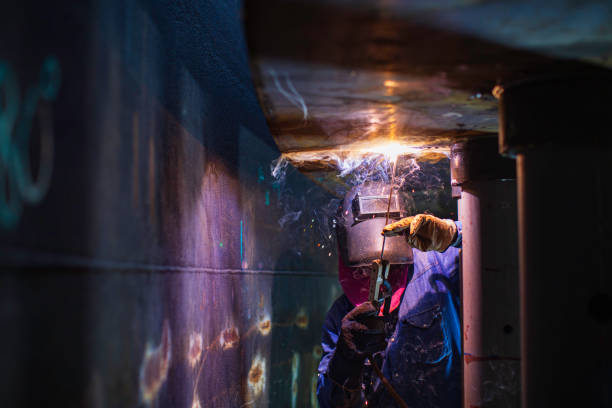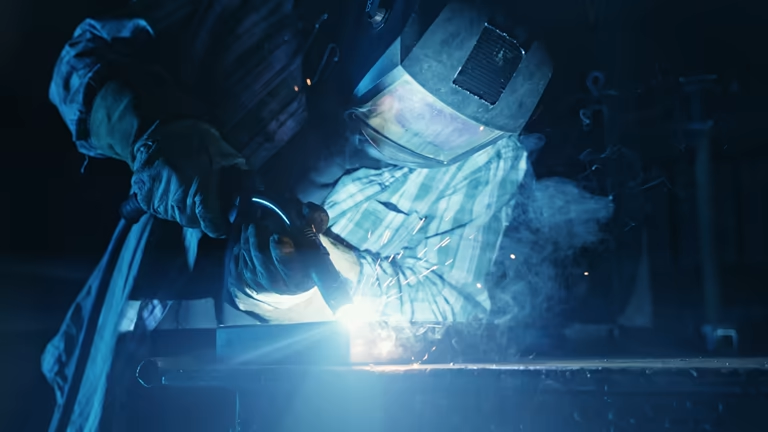
Imagine this: You’re working on a highly demanding TIG welding project, where every weld joint is crucial to the final structural integrity. However, the world before you is shrouded in a somber, distorted “emerald green” filter.
For millions of welders, this green vision is their daily barrier between themselves and the world. While traditional welding helmets protect the eyes from burns, compromises in color and clarity subtly limit your work potential and welding precision .
But now, technology has ushered in a new era: True Color (or Natural Color) technology is revolutionizing that. This isn’t just a fancy gimmick; it’s a real innovation that can improve your work performance and protect your long-term health. This article will reveal how this technology works and tell you why it will be a crucial upgrade in your toolbox.
I. Technological Revolution: Why Must We Say Goodbye to Traditional “Green Light”?
Before delving into the details of natural-colored welding helmets , we must first understand past standards—and their limitations.
Blind spots of traditional welding helmets
Traditional welding masks primarily rely on inexpensive dyed glass or basic filters. Their core function is to block harmful ultraviolet (UV) and infrared (IR) rays, which they do quite well.
However, to achieve their light-blocking effect, they employ a rather crude approach to processing the visible light spectrum . They filter out a large amount of the spectrum except for green, especially red and blue light. The result is:
Visual distortion: Everything you see is a single shade of green, and you can’t distinguish the original colors of materials, the colors of marking lines, or even the hazard lights in the surrounding environment.
Low-resolution experience: This visual distortion, combined with the optical blur that low-cost lenses are prone to , significantly reduces the clarity of your field of vision.
Eye strain: Your brain needs to constantly work to adapt to and correct this green distortion. Over time, visual fatigue is an unavoidable occupational problem.
“Natural Color” Technology: Full-Spectrum High-Definition Display
The “Natural Color” technology can be understood as bringing a 4K HDR experience to your welding helmet . Instead of simply using crude filtering, it employs a more sophisticated strategy:
High-precision LCD panel: It relies on a high-precision LCD panel and advanced multi-layer optical coating .
Broad spectrum transmission: This technology optimizes the transmission of red and blue in the visible light spectrum , rather than just allowing green. This means that whether in a bright state (without arcing) or a dark state (after arcing), the colors you see are very close to the colors in the real world .
Optical Grade Guarantee: This technology almost always comes with the highest optical quality grade 1/1/1/1 , ensuring high-definition display , eliminating distortion and blur, and guaranteeing that you can see a clear image from any angle.
II. Core Indicator: How can natural coloration improve your welding precision?
A more realistic field of vision directly equates to higher welding precision and less rework. Here are the four key advantages of naturally colored welding helmets in the workplace:
1. Improve weld pool control in TIG/pulse welding
In delicate work such as TIG welding, which requires extremely high control over heat input and molten pool, the color and fluidity of the molten pool are key signals for welders to judge the temperature.
Traditional helmets: Under green vision, all colors are flattened, making it difficult to distinguish whether the molten pool is an overheated bright yellow or an ideal orange-red .
Natural color helmet: Allows you to observe the true color, temperature gradient, and flow state of the molten pool more clearly . This enables you to more precisely control the welding torch speed and current adjustment, thereby optimizing weld quality . This is especially important when processing expensive alloys or structural components requiring ultra-high precision.
2. Precise positioning and reduced rework
Before striking the arc, you need to precisely position the electrode at the edge of the weld, the starting point of the bevel, or a pre-marked line.
Natural color welding helmets allow you to clearly distinguish the true color of marking lines in bright light (such as white paint or blue lines), and even maintain this color discrimination ability at the moment of arc initiation (dark light).
Result: You can accurately position the weld , avoid deviations from the weld seam or incorrect starting point, and reduce rework and material waste caused by inaccurate positioning .
3. Effectively reduces visual fatigue and occupational risks.
If your welding helmet causes dry eyes and a splitting headache after four hours of work, you’re experiencing visual fatigue. This fatigue not only affects your health but also directly threatens your work stability and accuracy .
Natural color technology provides a more comfortable and natural viewing experience, eliminating the need for the brain to overcompensate for distorted colors.
result: Reduce visual fatigue , improve your focus, accuracy and safety during long working hours , and effectively reduce welding defects and accidents caused by distraction.
4. Enhance environmental safety awareness
In noisy factory environments, the colors of safety signs and warning lights are important nonverbal signals.
A naturally colored welding helmet allows you to more clearly identify the red emergency stop button , blue danger zone indicator light , or a colleague’s yellow hard hat in your peripheral vision, even while welding . This may sound like a small thing, but in the rapidly changing industrial environment, it can significantly improve workplace safety .
III. Selection Tips: How to find your “natural color” helmet?
You’ve decided to upgrade, but how can you ensure you’re not getting a fake “HD” product? Remember these key points:
Product description keywords: Look for models that explicitly state “True Color” , “Natural Color” or “High Definition Display Technology” .
Optical rating is a critical indicator: ensure the helmet meets the highest optical rating of 1/1/1/1 . This represents the lowest possible distortion, blur, light uniformity, and angle dependence. This is the best evidence of the performance of the natural color technology.
Light Shade: Excellent natural color welding masks typically have a low light shade (such as DIN 2.5 or DIN 3.0), which means that the lens is closer to transparent and the field of view is brighter when not arcing.
Brands and Prices: Natural color rendering is a technology that requires expensive LCD panels and sophisticated coatings to achieve. For example, high-end models from well-known brands like 3M Speedglas typically feature this technology. If a helmet is cheap and claims to have “natural color rendering,” you should be wary.
Conclusion: Investing in a clearer future
In welding, an industry that demands extremely high levels of skill and patience, no piece of equipment in your toolbox should limit your skills. The “Natural Color” welding helmet is not just an upgrade in protective gear; it’s a strategic investment in your occupational health and welding precision .
Ditch the traditional green vision and choose a welding helmet that brings the colors of the real world to your eyes . You’ll not only see welds more clearly, but your eyes will thank you.
Have you experienced the visual enhancement brought by natural color rendering technology? Share your thoughts in the comments section: which welding job do you think needs this high-definition view the most?