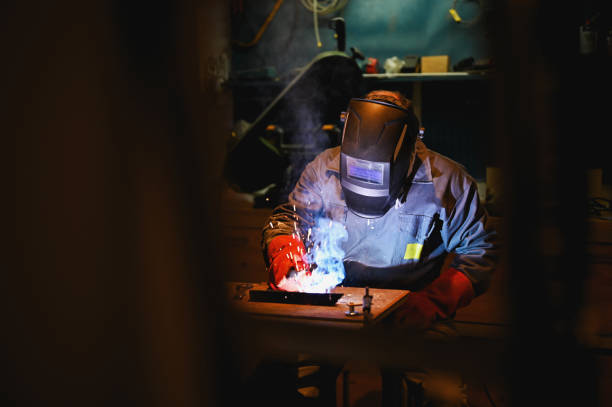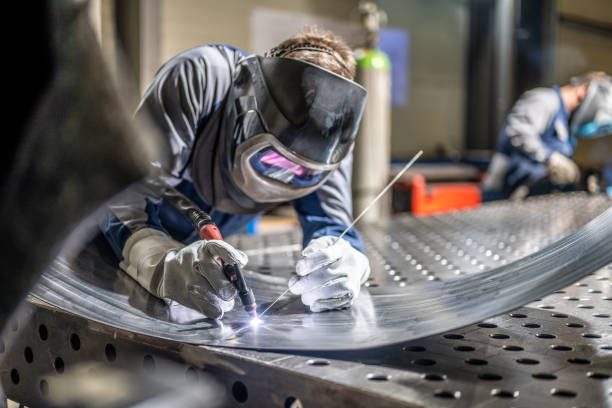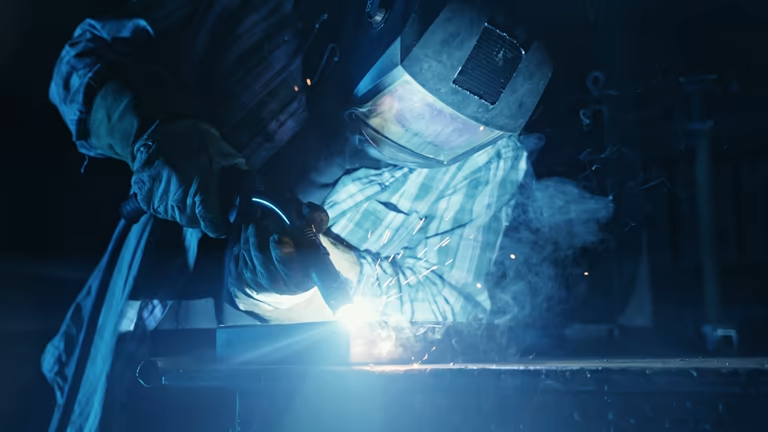
In a welding workshop, safety is always the non-negotiable bottom line. Your welding helmet is a critical investment in your career; it must reliably protect you from ultraviolet (UV) and infrared (IR) radiation, as well as the physical impact of molten slag splashes.
However, in a market flooded with welding helmets of various brands and prices , how can you be sure that the helmet you buy can really withstand the test of arc light and high-speed impact?
The answer lies in those seemingly mysterious codes and markings: ANSI and CE certifications. These aren’t just random stickers; they are endorsements of the safety and performance of welding helmets from two of the world’s most authoritative organizations . This article will delve into the true meaning behind these welding standards , teaching you how to decipher the “safety ID card” on your helmet.
I. North American Cornerstone: ANSI Z87.1 —A commitment to withstand physical shocks
In the United States and Canada, ANSI (American National Standards Institute) is the gold standard in the field of eye and face protection. Its core standard, ANSI Z87.1, sets forth stringent safety requirements for welding helmets used in occupational and educational settings .
It’s not just about “blocking light,” it also needs to be “impact resistant.”
ANSI Z87.1 focuses on physical protection , ensuring that your welding helmet shell and visor can withstand the various impacts and hazards that may be encountered in the working environment:
High-speed impact test: Helmets must be able to withstand impacts from steel balls or sharp objects of specified speed and weight to prevent flying metal fragments from penetrating the protective visor. A helmet marked “Z87+” indicates that it has passed the high-impact protection test.
Material fire resistance: Helmet materials must have sufficient fire resistance and self-extinguishing properties to cope with combustion that may be caused by electric arcs or sparks.
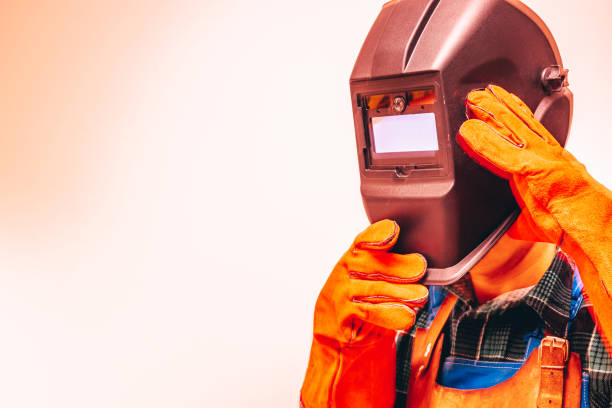
An enduring commitment to filters
In addition to physical protection, ANSI certification has specific requirements for light filters, which is also crucial for the safety of welding helmets :
Permanent UV/IR protection: This is one of the most critical requirements of ANSI Z87.1 . It ensures that the automatic dimming filter provides 100% protection against ultraviolet and infrared radiation even when the helmet is not powered on, in bright light, or in the event of a battery malfunction . This means that even if the helmet malfunctions, you will not be burned by arc radiation.
II. European Standards: CE EN379 —A scientific rating focusing on optical performance
If you purchase a welding mask from an international manufacturer, you will likely see the CE certification mark. The most important welding specification is EN379 , a European standard specifically for automatically adjusting welding filters .
The four ratings of EN379: Your helmet’s optical “health check report”
ANSI , which focuses on impact testing , EN379 places greater emphasis on the optical performance of auto-dimming filters . It requires filters to be scientifically rated on four key indicators, ranging from 1 to 3, with 1 being the highest rating :
Optical Class: Visual clarity. A rating of 1 means the lens has virtually no distortion or blurring, which is key to reducing long-term visual fatigue for welders .
Diffusion of Light Class: Measures the degree of scattering or blurring that occurs when light passes through a lens. A rating of 1 means a cleaner field of view with very little cloudiness or halo.
Variation of Luminous Transmittance Class: This checks the uniformity of the lens’s light-blocking effect. Rating 1 ensures that the light-blocking effect you see is consistent throughout your field of vision.
Angle Dependence Class: Measures the degree of light obstruction change when viewed from different angles (such as a slight tilt of the head). A rating of 1 means stable performance with no issues of “darkening” or “brightening” when viewed from the side.
Industry Gold Standard: 1/1/1/1 Rating
When choosing a high-end welding helmet , look for the “EN379 1/1/1/1” mark. This is the highest standard of optical performance under CE certification , representing the clearest, most stable, and most reliable field of vision. If you are engaged in high-precision welding work such as TIG welding, a 1/1/1/1 rating is essential to ensure welding accuracy.
III. Why do you need to pay attention to both ANSI and CE certifications?
If you purchase a high-quality welding mask sold in the international market , it will usually have both ANSI and CE certifications, which means that your protection meets dual global standards.
Double protection: ANSI ensures your helmet won’t crack or burn on your head (physical safety), while CE EN379 ensures your automatic dimming function won’t damage your eyes (optical safety).
Return on investment: Purchasing a helmet certified by authoritative welding standards is not only a responsible choice for your own health but also a guarantee of work efficiency. Inferior helmets may cause long-term visual damage due to poor optical performance or lead to accidents due to insufficient impact resistance.
Conclusion: Your safety is non-negotiable.
ANSI/CE certifications are the globally recognized language for measuring the protective capabilities and performance levels of welding helmets . They transform the task of choosing a welding helmet from blind guesswork into an informed decision based on scientific standards.
The next time you purchase or use your welding mask , be sure to check the welding specification markings on the lens and housing . Remember: Z87+ is a commitment to impact resistance; EN379 1/1/1/1 is a guarantee of clear vision.
Take immediate action: Pick up your current welding helmet and check if its filter has the EN379 1/1/1/1$ marking. If your helmet does not have a clear certification mark, it may be time to consider upgrading your welding helmet safety equipment.