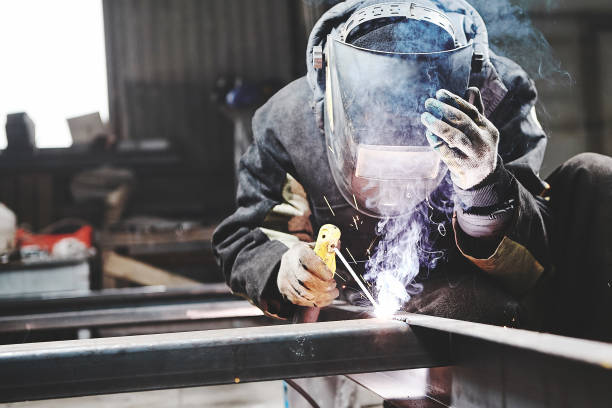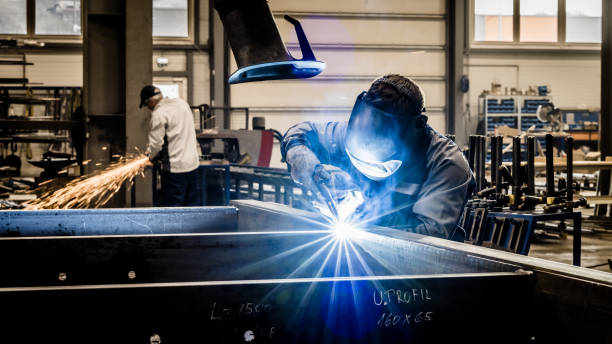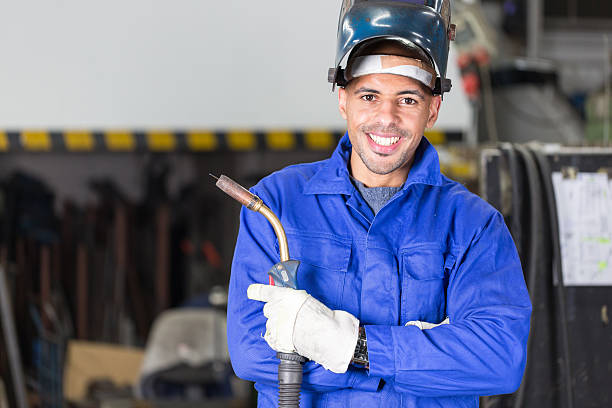
If you are a professional welder, then your welding helmet is your office chair, your steering wheel, and an indispensable partner that you rely on for hours every day.
Imagine this: You’re performing a challenging weld, but your welding helmet keeps tilting forward, forcing your neck muscles to tense up in resistance. Day after day, this seemingly insignificant burden eventually leads to neck pain, chronic shoulder stiffness , and a sharp decline in work efficiency. A poorly designed helmet is a “hidden killer” of your occupational health.
Choosing a welding helmet that’s comfortable to wear for extended periods involves more than just weight . This article goes beyond simple parameter tables, delving into the ergonomic design of welding helmets . It teaches you how to evaluate three core elements : perceived weight, weight balance , and the headgear system , helping you make a truly wise choice that protects your health.
I. Pillar One of Comfort: The Mystery of “Net Weight” and “Perceived Weight”
When you pick up a welding helmet , you pay attention to its net weight. But more importantly, how heavy does it “feel” to be on your head?
Revealing the actual weight range and safety baseline of helmets
high-quality welding helmets equipped with auto-dimming lenses typically weigh between 500 and 800 grams (approximately 1 to 1.8 pounds). While lighter is generally better, be aware that extreme lightweighting can mean the outer shell plastic is too thin, sacrificing protection against high-speed impacts.
The core of H ergonomics : Sense of weight
Perceived weight is a core concept in ergonomics . It refers to the actual pressure and burden felt by the user when wearing the helmet. A 700-gram helmet, if properly balanced and evenly distributed, may feel lighter and more comfortable to wear than an unbalanced 600-gram helmet.
How to evaluate:
Checking the data: Understanding the net weight is the first step.
User feedback: Pay attention to the comments from experienced welders about neck fatigue after wearing it for a long time . This is the most direct feedback on the perceived weight and is more convincing than any number.
II. Comfort Pillar Two: counterweight balance —The Silent Killer of Neck Pressure
Weight can be distributed, but the pressure from torque is irreversible. This is the most subtle and crucial aspect of the design of a welding helmet .
Why is balance more important than weight? — The principle of torque
Think of a lever. If the center of gravity of a welding helmet is too far forward (the visor is too heavy), even if the total weight is only as light as a bottle of water, the forward-leaning torque will act like a continuous pulling force, constantly pulling your head downwards. To counteract this force, your neck muscles must be in a state of tension for a long time, which is the culprit behind chronic neck pain and fatigue.
Ideally, the ideal design for a welding helmet should place the center of gravity as close to the center of the head as possible , or slightly backward, so that the weight is evenly distributed on the top and back of the skull.
Check the adjustment pivot point of the head-mounted system.
Professional welding helmet manufacturers offer adjustable pivots (connection points). This allows welders to fine-tune the connection points between the helmet and the headgear system to optimize their center of gravity position , based on their head shape and working posture .
Practical tips (simple tests before purchase):
Wear a helmet and ensure the head-mounted system is adjusted for comfort.
Flip the helmet up (in the light).
Release your grip. If the helmet stays stably in the flipped-up position, its weight balance is good; if it immediately tilts forward or backward, its balance may not be suitable for you.
III. Comfort Pillar Three: Head-mounted system Personalized Adaptation and Stress Reduction Design
The headgear is the helmet’s suspension system, and its design determines the upper limit of comfort.
Reliable adjustment and locking mechanism
Ratchet Adjuster: Check that the ratchet adjuster on the back of the helmet is smooth, precise, and remains securely locked. A headgear system that may loosen during welding not only affects comfort but also poses a serious safety hazard.
Multi-point adjustment: A high-quality headgear system doesn’t just allow you to adjust the head circumference. It should also offer depth (height) and tilt angle adjustments, allowing you to perfectly fit the welding mask to your face and field of vision.
Stress Reduction and Hygiene Design
Sweatband: Look for a soft, absorbent, and easy-to-remove washable sweatband . It not only absorbs sweat, but more importantly, it provides cushioning, preventing the hard plastic of the headband system from directly pressing on your forehead and distributing pressure.
Top contact point: Observe the top of the head-mounted system . Ideal ergonomic design does not concentrate all the weight on a narrow band, but rather distributes the pressure evenly on the top of the skull through a “cross” or multiple wide bands, achieving maximum decompression**.
Conclusion: Invest in your health by choosing the right products. Welding helmet
Choosing a comfortable welding helmet that you can wear for extended periods is one of the best investments you can make in your career.
Remember, true comfort comes from lightweight construction, excellent weight balance , and a customizable and pressure-reducing headband system . Don’t let a poorly designed tool become an obstacle to your productivity and health .
Take action now: the next time you try out a welding helmet , don’t just focus on checking the visor. Spend a few minutes wearing it and moving your head up, down, and left and right to personally feel whether its weight balance truly makes you feel comfortable. You’ll find that these few minutes of testing will save you years of neck pain.